

Disclosure: We earn commissions when you shop through the links below.
In 2026, compute is cheap, but moving your data is terrifyingly expensive. As applications become increasingly media-rich and AI-driven, data transfer rates have skyrocketed. While founders obsess over CPU and RAM limitations, the true silent killer of modern cloud budgets is hidden deep within the pricing pages of major hyperscalers: Egress Fees.
"Egress fees are the cost of moving your own data out of a cloud provider’s network. Hyperscalers use it not just for revenue, but as a mechanism for vendor lock-in. Once your data is there, it's too expensive to leave."
The 2026 Reality: The Bandwidth Tax
Let’s look at the standard "Modern Web" stack. A team deploys a Next.js or SvelteKit application on Vercel or AWS. Initially, everything is fast and cheap. But as traffic scales, they hit the "Bandwidth Wall."
Providers like AWS charge between $0.09 and $0.15 per GB for outbound data transfer. Managed frontend platforms often mark this up even further after you cross your included limits. If your application streams video, serves heavy AI-generated assets, or has millions of dynamic page views, your egress bill will quickly eclipse your compute bill.
| Egress Volume | AWS / GCP (Avg) | Vercel (Overage) | Hetzner VPS |
|---|---|---|---|
| 1 TB | ~$90.00 | ~$150.00 | $0 (Included) |
| 10 TB | ~$900.00 | ~$1,500.00 | $0 (Included) |
| 50 TB | ~$4,500.00 | ~$7,500.00 | ~$33.00 (Overage) |
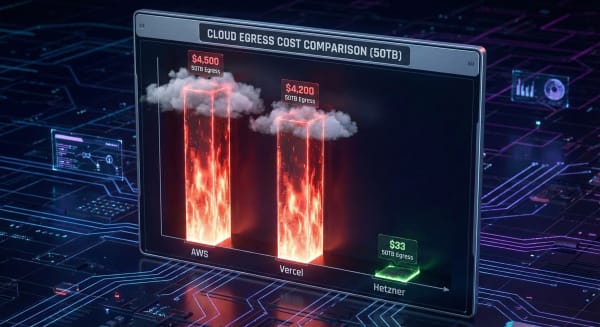
Figure 1: The staggering cost difference in 2026 cloud egress fees.
The DevMorph Solution: Hybrid Sovereignty
At DevMorph, we don't just complain about pricing; we engineer around it. We advocate for an architectural approach we call "Hybrid Sovereignty." Instead of relying on a single vendor for compute, storage, and delivery, we decouple the stack to exploit the best unit economics from different providers.
- Compute & Bandwidth (Hetzner): We host the core application using Coolify v4 on a Hetzner VPS. Most Hetzner servers come with a massive 20TB of included outbound traffic, and overages cost roughly €1 per TB.
- Security & Caching (Cloudflare): We place Cloudflare in front of the Hetzner server. Cloudflare caches the HTML and static assets globally, absorbing 70%+ of the traffic before it even hits the VPS.
- Asset Storage (Cloudflare R2): Instead of expensive AWS S3, we use Cloudflare R2 for user uploads and images. Why? Because R2 has zero egress fees.
Implementation: Bypassing Native Optimization APIs
A common trap developers fall into is using the native <Image /> components in Next.js or SvelteKit without configuring them. By default, these rely on the hosting platform's (like Vercel's) image optimization APIs, which are heavily metered and quickly spike your bill.
To achieve Hybrid Sovereignty, you must configure your framework to offload image optimization to an external, cheaper CDN.
SvelteKit / Cloudinary Implementation
// DevMorph Best Practice: Using an external CDN string in SvelteKit
<script>
  export let imageId;
  // Constructing a Cloudinary or custom CDN URL directly
  // Bypassing any expensive server-side optimization
  const optimizedUrl = `https://res.cloudinary.com/dlj9khi7b/image/upload/c_limit,w_800,q_auto,f_auto/${imageId}`;
</script>

<img src={optimizedUrl} alt="Optimized asset" loading="lazy" />
Next.js Custom Loader implementation
// next.config.js - Disabling expensive native optimization
module.exports = {
  images: {
    loader: 'custom',
    loaderFile: './my-custom-loader.js',
    // Alternatively, for fully static exports:
    unoptimized: true,
  },
}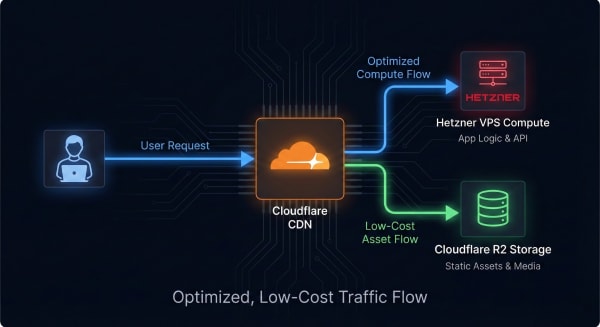
Figure 2: Architectural Arbitrage - routing heavy assets around expensive egress paths.
The Verdict: Architectural Arbitrage
Paying $4,500 for bandwidth that should cost $30 isn't just a technical oversight; it's a strategic failure. By leveraging Hetzner's generous bandwidth allowances and Cloudflare's zero-egress object storage, you can achieve "Architectural Arbitrage." You get the performance and global delivery of a hyperscaler, with the predictable, low-cost economics of bare-metal servers.
Bleeding Money on Cloud Egress?
If your Vercel or AWS bill is skyrocketing due to bandwidth and image optimization fees, it's time to take control of your stack. DevMorph specializes in migrating enterprise applications to high-performance, cost-predictable infrastructure.
Book an Infrastructure Audit