The traditional agency model is fundamentally broken. If you are still selling "custom website development" by the hour in 2026, you are competing in a brutal race to the bottom. With the commoditization of basic coding tasks, clients no longer want to pay for your time; they want to pay for a specific business outcome.
At DevMorph, we realized that to scale our revenue without burning out our engineering team, we had to stop acting like traditional freelancers scrambling on job boards and start acting like a software factory. If you have been searching for the best Upwork alternatives in 2026, the ultimate alternative is leaving the hourly bidding war entirely. The secret? Productized Services.
"Productizing a service means packaging your complex technical skills into a standardized, fixed-price, and repeatable offering. You sell a defined, high-ROI result, not a timesheet."
The Market Shift: Demand for AI Agent Developers vs Web Developers 2026
Let's look at the raw data. One of the most frequently asked questions we get is, will AI replace web developers in 2026? The answer is found in enterprise budget allocations. The demand for AI agent developers vs web developers has heavily skewed towards automation and sovereign infrastructure. A standard React or WordPress developer is now competing with generative UI tools that can scaffold a landing page in seconds.
However, businesses are desperately hunting for engineers who can build autonomous AI agents, optimize cloud infrastructure, or drastically improve enterprise application performance. The skill gap in these deep-tech areas is massive, and client budgets reflect that scarcity.
| Metric | Standard Web Dev | AI / DevOps Architect |
|---|---|---|
| Market Positioning | Commoditized (Cost-driven) | Specialized (Value-driven) |
| Billing Model | Hourly ($ / hour) | Fixed Package ($$$ / outcome) |
| Profit Margins | Low (Capped by hours) | High (Driven by system efficiency) |
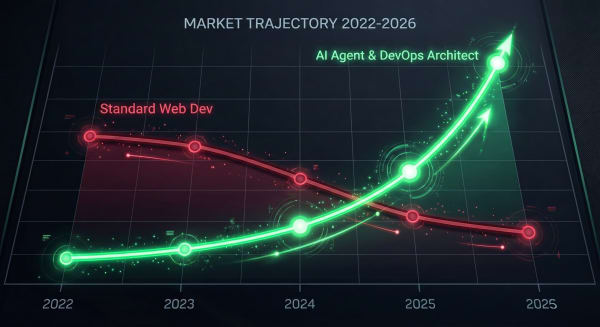
Figure 1: The widening gap in enterprise tech budget allocation (2024 - 2026).
How to Productize Your Agency: The DevMorph Playbook
When you sell general "development," the client controls the scope and micromanages the process. When you sell a "productized service," you control the scope. Here is exactly how we transformed our service menu at DevMorph to align with modern enterprise needs.
Package 1: The "Vercel Exit" Strategy (DevOps)
As we detailed in our Coolify v4 Migration Guide, scaling SaaS companies are bleeding money due to aggressive Vercel bandwidth egress pricing.
- The Problem: Unpredictable, skyrocketing managed hosting bills that kill profit margins.
- The Productized Solution: A flat-fee, zero-downtime migration to a self-hosted VPS environment using Docker and Coolify.
- The Infrastructure: We exclusively deploy these solutions on dedicated VPS instances. This provides enterprise-grade NVMe SSDs, predictable flat-rate pricing, and completely eliminates bandwidth overage anxiety.
- The Deliverable: A fully containerized deployment pipeline and a predictable infrastructure bill.
Package 2: The Core Web Vitals Rescue (Performance)
Massive React applications naturally bloat over time, leading to slow load times and penalized search rankings. We proved this extensively in our SvelteKit vs Next.js 16 benchmark report.
- The Problem: Failing Google's Core Web Vitals (specifically LCP and INP), causing lost SEO traffic and dropping conversion rates.
- The Productized Solution: A complete frontend rewrite utilizing the blazing-fast Svelte 5 Runes compiler.
- The Deliverable: A guaranteed 95+ Lighthouse performance score, a 65% smaller JavaScript bundle size, and sub-second Time to Interactive (TTI).
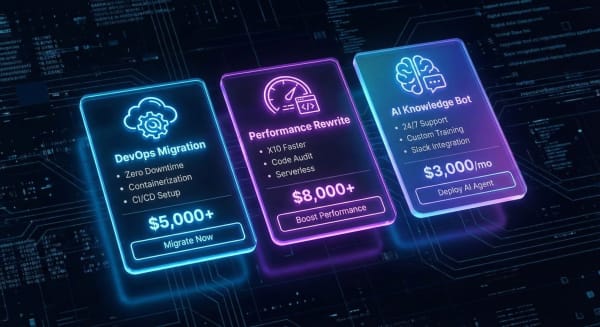
Figure 2: Moving from ambiguous hourly rates to high-value productized service tiers.
Package 3: The Internal Knowledge Agent (AI Engineering)
Every mid-sized company has vital internal documentation scattered chaotically across Notion, Slack, and Google Drive.
- The Problem: Employees waste up to 20% of their day just searching for internal company information and SOPs.
- The Productized Solution: A secure, locally-hosted RAG (Retrieval-Augmented Generation) AI agent trained exclusively on their proprietary data.
- The Deliverable: A turnkey, private chatbot portal where employees can ask natural language questions and receive instantly sourced, accurate answers.
The Agency Growth Mindset
By productizing these advanced services, you drastically reduce proposal writing time and client friction. When a client approaches DevMorph today, we don't ask, "What do you want us to build?" We state with authority: "Here are the three specific, high-ROI business problems we solve. Which one is currently hurting your bottom line?"
This approach builds massive industry authority. It allows your agency to build internal templates, boilerplate code, and deployment scripts. A productized service you sell for $5,000 might only take your team 12 hours to execute because the internal process is already perfected. That is how you scale.
Something worth reflecting on:
Most agencies fail to scale not because they lack technical skill — but because they never stopped trading hours for money. A productized service forces you to systematize your best work. Which of the three packages above maps closest to the problem your best clients are already paying you to solve?
Disclosure: This article contains some affiliate links. If you sign up through them, we earn a small commission that helps keep this blog running — at no extra cost to you.