
It’s 2026. You just shipped a complex SaaS MVP in four days using Devin 3.0 and GitHub Copilot Workspace. The stakeholders are thrilled. The UI looks crisp. The Stripe integration works.
Two weeks later, a critical bug appears in the authentication flow. You open the repository to fix it, and you freeze.
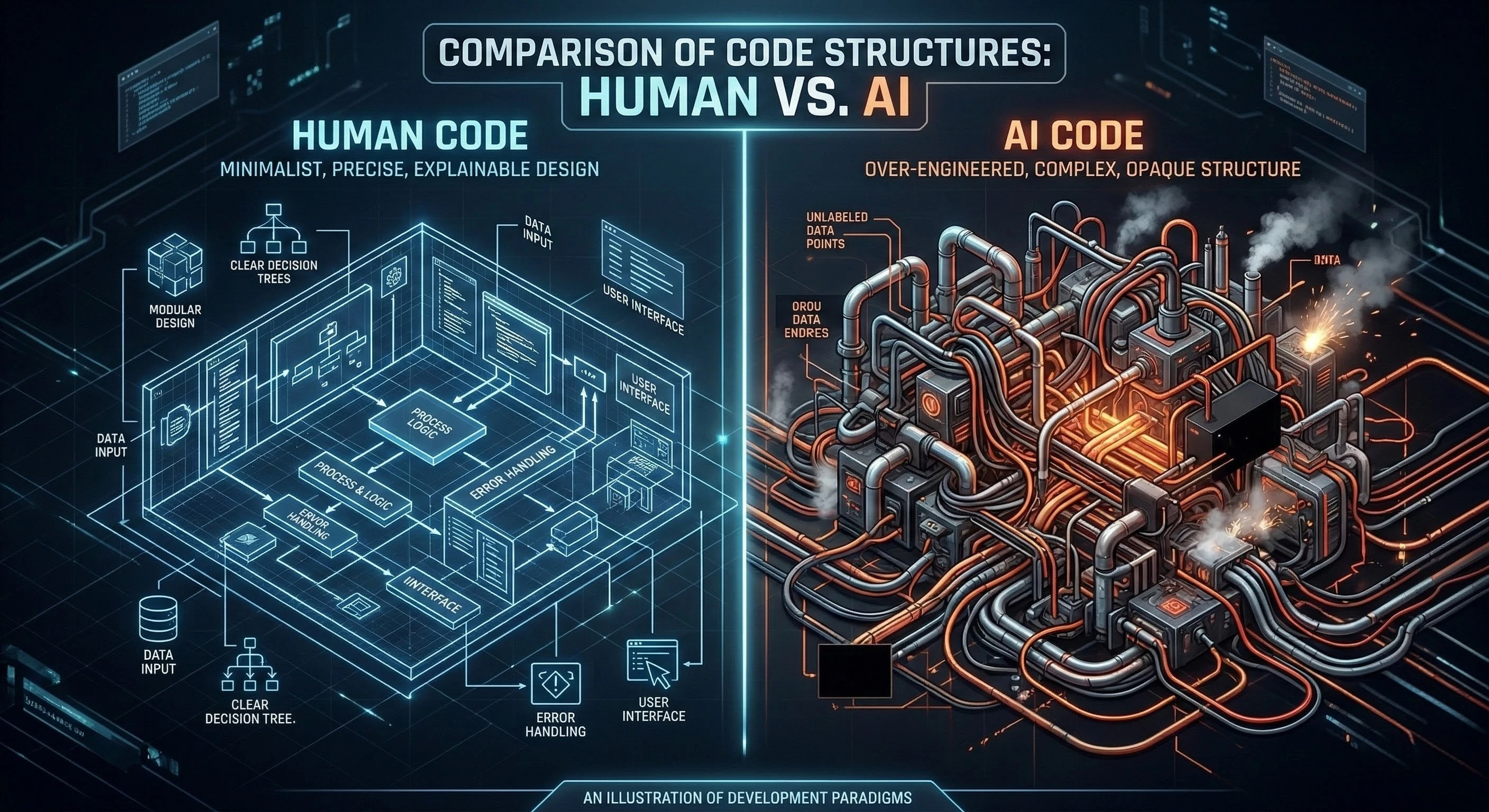
You see 400 lines of boilerplate where 50 would have sufficed. You see three different state management patterns used in the same module. You see code that works, but you have zero idea why.
Welcome to the era of AI Technical Debt.
The "Sugar Rush" of Generative Coding
In 2024, we worried about AI taking our jobs. We discussed if developers would be replaced. By 2026, we know the truth: AI didn't replace us; it made us sloppy.
Speed has become the only metric that matters. But in engineering, speed without precision is just debt. AI tools are optimized for completion, not maintenance. They are trained on the internet's average code—which is often verbose, outdated, or insecure.
The Maintenance Trap
"Code is a liability, not an asset." The more lines of code you have, the more surface area exists for bugs. AI tends to generate verbose solutions because it lacks the context to abstract effectively.
Anatomy of AI-Generated Sprawl
Why exactly is AI code harder to maintain? It usually comes down to three factors we see constantly at DevMorph:
- Context Hallucination: The AI assumes a library exists or a function works a certain way when it doesn't, leading to weird wrapper functions to force it to work.
- Inconsistent Patterns: File A uses Functional Programming. File B uses OOP. File C uses a pattern from a 2019 StackOverflow thread.
- Bloat: AI rarely refactors. It adds. If you ask for a feature, it appends code rather than modifying existing logic to accommodate it cleanly.
The "Reviewer" Crisis
Here is the uncomfortable truth about 2026: Humans are terrible at reading code.
We are builders. We like writing. When Copilot spits out a 50-line function, our brain skims it. "Looks right," we say. We hit Tab. We hit Commit.
This behavior creates a "Black Box" codebase. When something breaks, you can't debug it because you never really understood it in the first place. You are effectively maintaining a stranger's code, but that stranger is a stochastic parrot running on a GPU server.
// Typical AI "Safe" Code (Verbose & Hard to Read)
const processUserData = (users) => {
  if (!users) return [];
  let results = [];
  for (let i = 0; i < users.length; i++) {
    if (users[i] && users[i].isActive === true) {
      let formatted = {
        id: users[i].id,
        name: users[i].name ? users[i].name.toUpperCase() : 'UNKNOWN',
        // ... 20 more lines of defensive mapping
      };
      results.push(formatted);
    }
  }
  return results;
};
Versus the code a Senior Engineer would actually write:
// Human Intent (Clean & Maintainable)
const processUserData = (users) =>
  users?.filter(u => u.isActive)
       .map(u => ({
         id: u.id,
         name: u.name?.toUpperCase() ?? 'UNKNOWN'
       })) ?? [];
Infrastructure Costs: The Silent Killer
Bloated code doesn't just hurt your brain; it hurts your wallet. Inefficient algorithms generated by AI consume more CPU cycles and memory.
If you are running on serverless platforms, you pay for that extra execution time. If you are self-hosting, you run out of RAM faster. This is why we advocate for controlling your own infrastructure.
Switching to a VPS and using Coolify can save you from the "AI Bloat Tax," but only if your code isn't leaking memory like a sieve. On a self-hosted server, inefficient AI-generated code will drain your RAM and CPU far faster than clean, intentional code ever would.

Survival Guide: Developing in 2026
We cannot go back to typing every character manually. AI is here to stay. But we must change how we use it.
1. Treat AI as an Intern, Not an Architect
Never ask AI to "design the system." Design the interfaces and data structures yourself. Use AI only to fill in the implementation details. You own the blueprint; the AI lays the bricks.
2. The "Explain It" Rule
If you generate a block of code and you cannot explain exactly what every line does to a junior dev, delete it. Do not commit magic. Magic turns into legacy nightmares.
3. Aggressive Refactoring
Schedule "AI Cleanup" sprints. Dedicate time specifically to condensing and unifying the code AI generated during the feature rush.
Conclusion
AI Technical Debt is the asbestos of the 2026 web. It is built into the walls, it is invisible, and it will eventually become toxic.
The best developers of this year aren't the ones who prompt the fastest. They are the ones with the discipline to say "No" to the AI's first draft.
Is your codebase drowning in AI-generated mess?
At DevMorph, we don't just generate code; we engineer scalable, maintainable systems. Whether you need a SvelteKit architecture review or a complete DevOps pipeline overhaul, we build software that lasts.
Book a Technical AuditDisclosure: This article contains some affiliate links. If you sign up through them, we earn a small commission that helps keep this blog running — at no extra cost to you.