
It’s a story I see every week now. Let’s call him "Dev." Dev is a junior engineer in 2026. He has a stunning portfolio. In just six months, he built a SaaS boilerplate, a fitness tracker, and a Next.js e-commerce store.
On paper, Dev looks like a Senior Engineer. He uses Cursor, v0, and Claude 3.7 daily. He ships fast.
Then, he walks into a real technical interview at our agency. We don’t ask for LeetCode dynamic programming. We ask for something basic:
The Interview Challenge:
"Open a blank file. Write a function that fetches data from this JSON API, handles the loading state, and renders a list. No AI assistants allowed."
Dev freezes. The silence in the room is deafening.
He realizes—with horror—that he doesn't know the syntax for useEffect. He doesn't know how to handle a Promise rejection manually. He has never actually written a fetch request; he has only ever requested one.
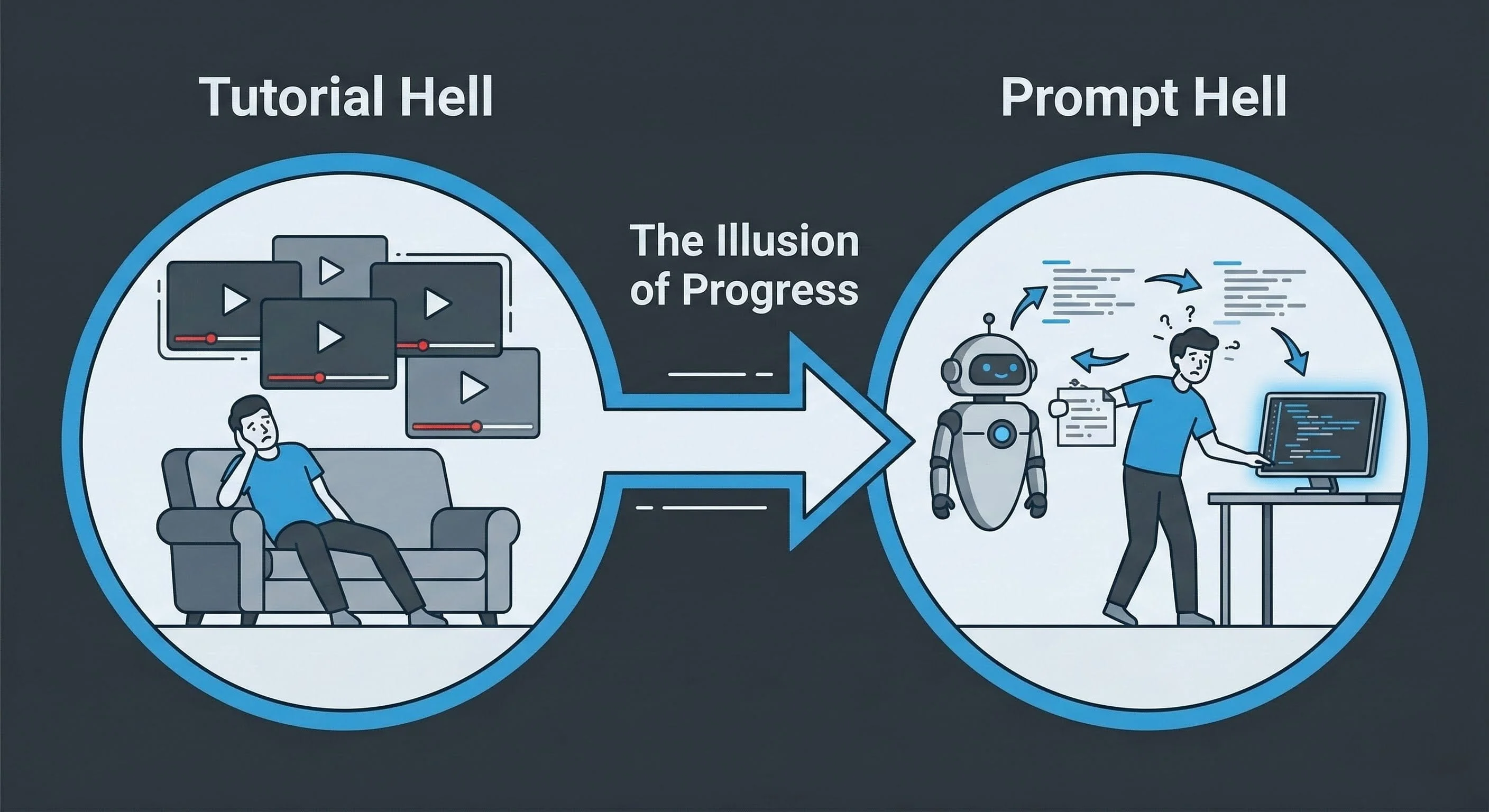
This is the crisis of 2026. We successfully escaped Tutorial Hell, only to fall headfirst into Prompt Hell.
The Anatomy of Prompt Hell
Back in 2023, beginners suffered from Tutorial Hell. You watched 10 hours of video, but when you opened a blank editor, you couldn't type a line. You knew you were incompetent. That feeling of incompetence was actually healthy—it pushed you to learn.
Prompt Hell is different. It is dangerous because it masks incompetence with The Illusion of Competence.
You feel like a god. You are "Vibe Coding." You are shipping features. But you aren't actually coding. You are just a middleman between a bug and a robot. You have become a glorified Clipboard Manager, moving text from Window A (The AI) to Window B (VS Code) without passing it through your brain.
The "Apology Loop"
You know you are in Prompt Hell when you enter the "Apology Loop." It usually looks like this:
- Step 1: You ask the AI to generate a feature.
- Step 2: You paste it. It throws a runtime error.
- Step 3: You copy the error stack trace and paste it back to the AI without reading it.
- Step 4: The AI says: "I apologize for the oversight. Here is the corrected code."
- Step 5: You paste the "fix." It breaks something else.
- Step 6: Repeat.
If you spend more than 30 minutes a day pasting error logs into an LLM, you are not debugging. You are gambling. You are hoping the probability machine guesses the right syntax before you run out of patience.
This is why I constantly tell students in our Web Development Roadmap that fundamentals matter more now than ever before.
The Rise of the "Hollow" Senior
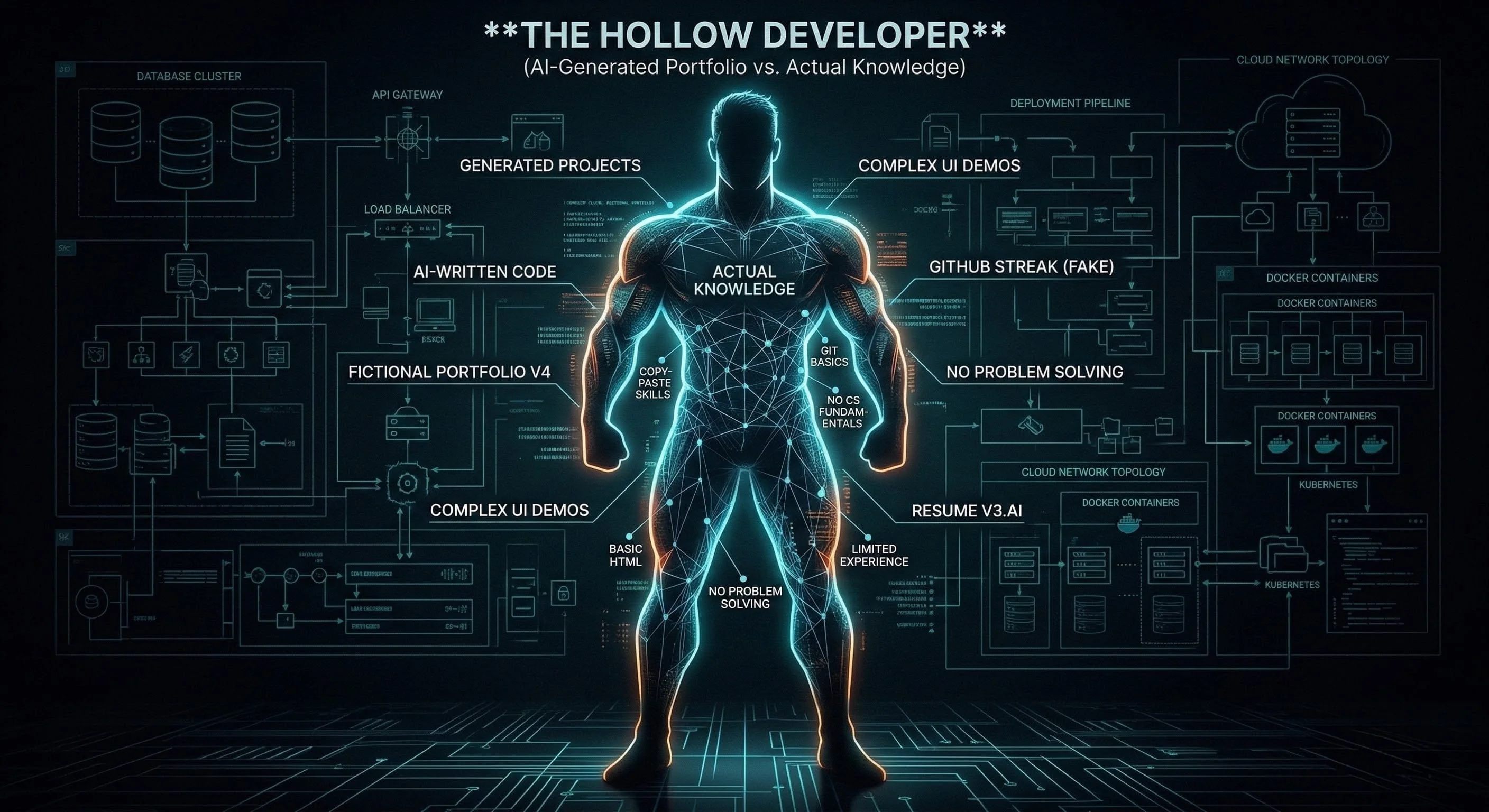
The most terrifying result of this era is the "Hollow Senior." These are developers who have 5 years of output compressed into 6 months of experience. Their GitHub activity is green, but their understanding is grey.
This hollowness gets exposed the moment you leave the "Happy Path." AI is fantastic at boilerplate. It is terrible at architecture, security boundaries, and complex state management.
When you deploy a "Vibe Coded" app to production, it works fine for 10 users. But when you hit scale, the lack of architectural understanding kills you.
Infrastructure Reality Check:
A "Hollow Developer" deploys to Vercel and prays the bill isn't high. A real engineer understands how to manage resources. If you want to break out of the "magic" mindset, try deploying your app to a raw VPS. It forces you to understand Linux, Nginx, and Docker — skills that AI simply cannot fake for you.
Case Study: The $5,00 Cloud Bill Mistake
Let’s look at a real-world example of "Vibe Coding" gone wrong. Last month, a client came to DevMorph with a Next.js application built entirely by a junior developer using AI prompts.
The app worked perfectly during the demo. But when they launched, their database costs spiked to $5,00 in one week. Why? Because the AI wrote "working" code, not "scalable" code.
Here is the code the AI generated for a simple user dashboard:
// The "Vibe Coded" Approach
const users = await db.users.findMany();

// AI logic: Loop through users and fetch their posts one by one
// Result: 1,000 users = 1,001 Database Queries (The N+1 Problem)
for (const user of users) {
    user.posts = await db.posts.findMany({ where: { userId: user.id } });
}
The AI logic is technically "correct"—it fetches the data. But it introduced the classic N+1 Query Problem. The AI didn't know that running a query inside a loop is a performance death sentence.
A human engineer knows to use a JOIN or a precise inclusion query. The AI just wanted to close the ticket.
We fixed this by rewriting the logic to execute a single optimized query. The cost dropped from $5,00 to $40 overnight. This is the difference between a "Prompt Engineer" and a "Software Engineer."
DevMorph Standard:
Before merging any AI-generated code, we run it through a "Scale Test." We ask: "What happens if 10,000 people hit this function at the same time?" If the answer is "the server crashes," the code is rejected.
This level of optimization is crucial when you are self-hosting. Inefficient AI-generated code will eat up your server's CPU instantly — and the AI won't warn you about that. Only real experience will.
How to Escape the Trap
I am not saying you should stop using AI. I use it every single day. But there is a difference between using AI as a Force Multiplier and using it as a Crutch.
If you have strong fundamentals, AI makes you 10x faster. If you have zero fundamentals, AI just helps you ship bugs 10x faster.
Here is the DevMorph protocol for Junior Developers in 2026:
The "No-Paste" Rule
- Never paste code you cannot explain to a 5-year-old.
- If AI writes a function for you, delete it. Then type it out yourself, character by character.
- Read the error logs BEFORE you give them to the AI. Make a hypothesis first.
We discuss this extensively in our article on whether AI will replace developers. The conclusion? It won't replace developers. It will replace coders who don't understand engineering.
The Final Verdict
Don't let the AI rob you of the struggle. The struggle is where the neural pathways in your brain are formed. When you bypass the struggle, you bypass the learning.
If you want to survive 2026, stop "Vibe Coding" and start engineering. Build something without an internet connection. Setup a self-hosted server. Write a raw SQL query.
Be the architect, not the clipboard manager.
A question worth sitting with:
When was the last time you wrote a function from scratch — no AI, no autocomplete, no Stack Overflow? If you can't remember, that's your answer. The fundamentals aren't going anywhere. Are you?
Disclosure: This article contains some affiliate links. If you sign up through them, we earn a small commission that helps keep this blog running — at no extra cost to you.