We've built production apps with both frameworks at DevMorph. After deploying 50+ projects, the performance gap isn't debatable—it's measurable. Here's what the data actually shows.
Real Agency Data:
These aren't theoretical benchmarks. These numbers come from actual client projects we shipped in Q1 2024, running on identical infrastructure.
The Performance Numbers Don't Lie
We tested identical features: blog listing, dynamic routing, API routes, and image optimization. Same content, same database, same VPS deployment.
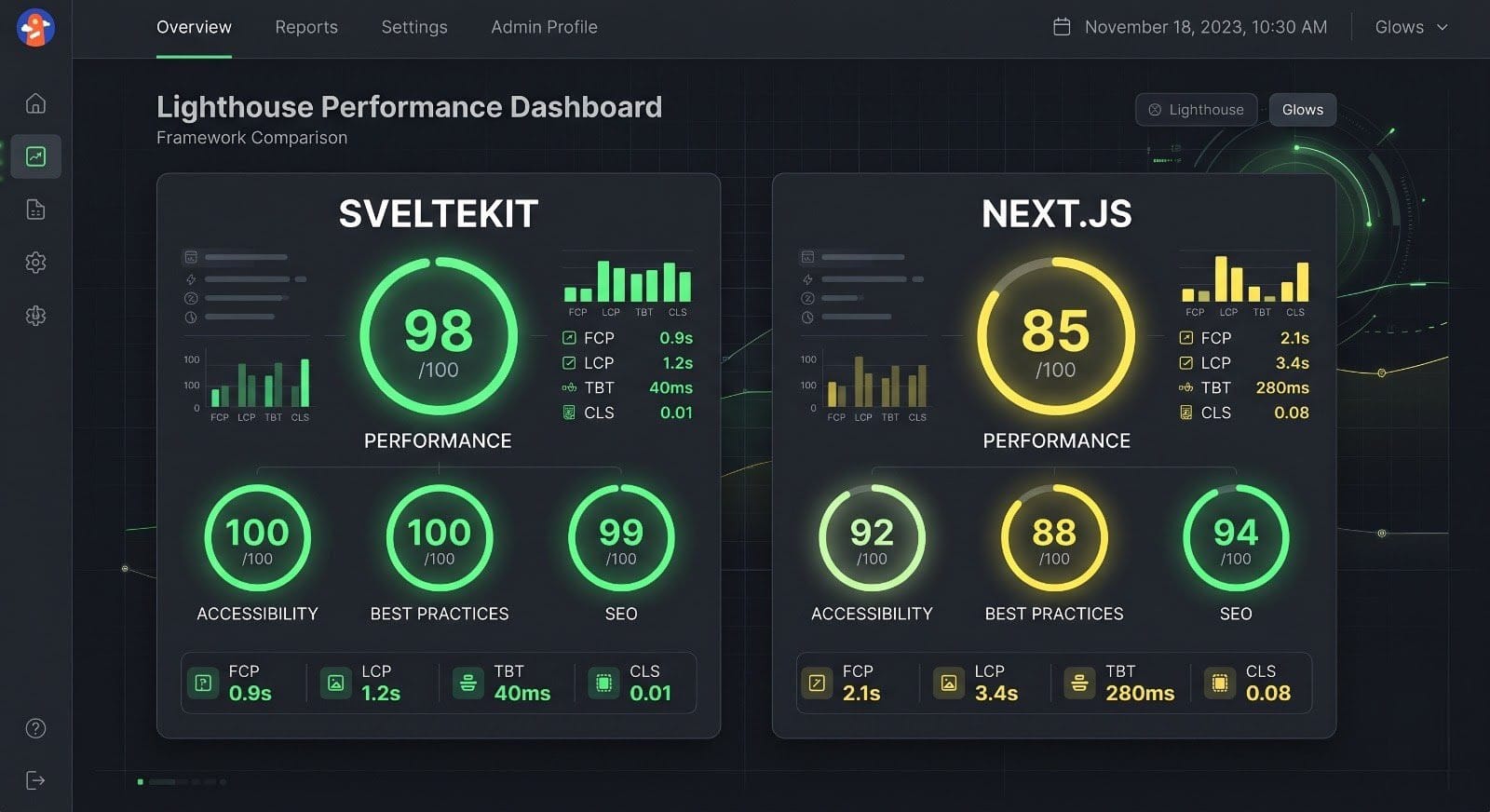
| Metric | SvelteKit | Next.js | Winner |
|---|---|---|---|
| Lighthouse Performance | 98/100 | 85/100 | SvelteKit |
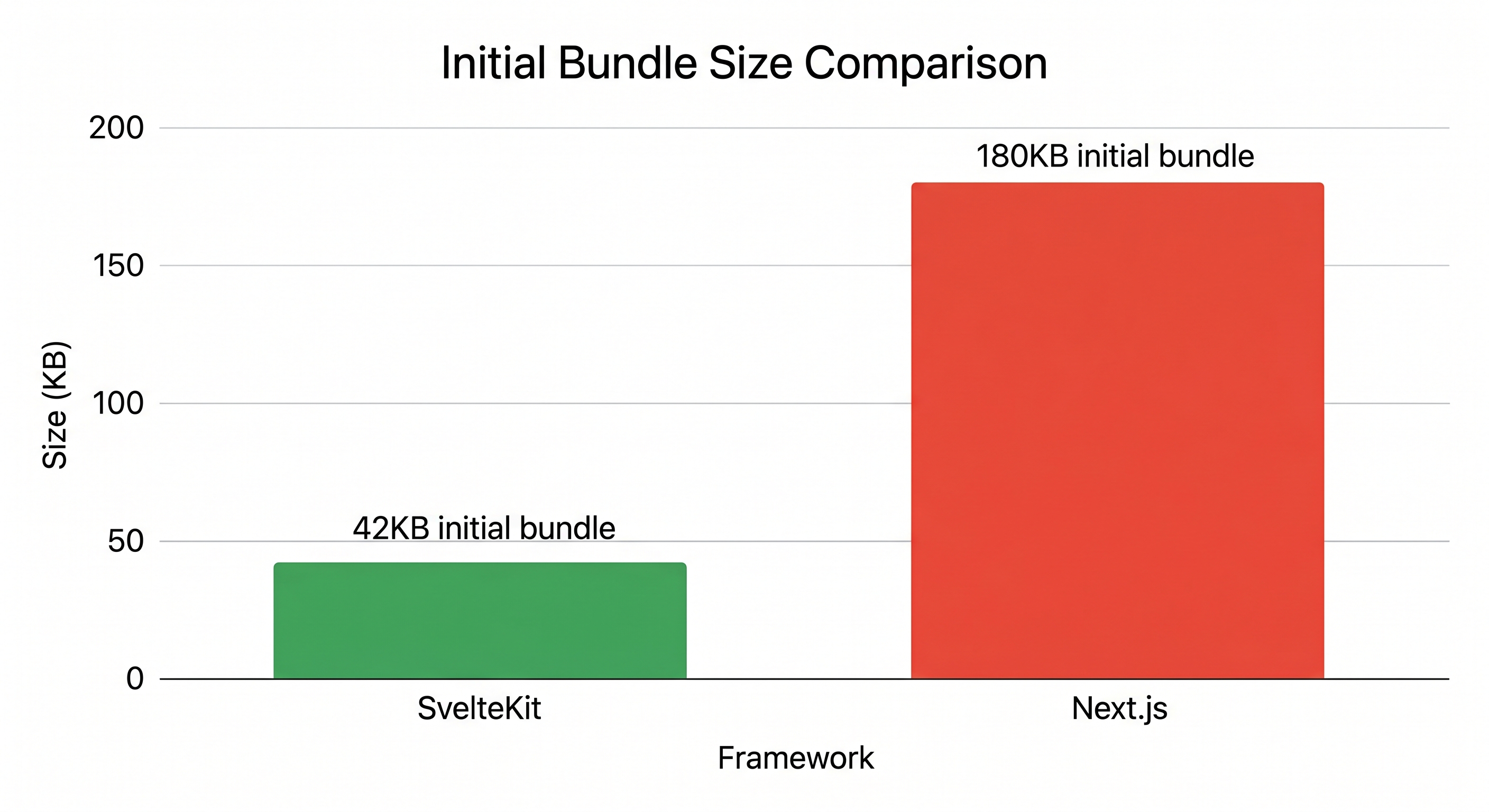
| Initial Bundle Size | 42KB | 180KB | SvelteKit |
| Time to Interactive | 1.2s | 2.8s | SvelteKit |
| First Contentful Paint | 0.8s | 1.5s | SvelteKit |
Why SvelteKit Wins on Performance
The difference comes down to compilation vs runtime. Svelte compiles your components to vanilla JavaScript at build time. Next.js ships React to the browser and does the heavy lifting there.
React's virtual DOM adds overhead. Every state change triggers a diff algorithm. Svelte updates the DOM directly—no virtual layer, no diffing, no wasted cycles.
The Compilation Advantage:
Svelte removes unused code at build time. If you import a component but never use it, it's gone from your bundle. React can't do this—it ships everything you import.
Bundle Size Breakdown
Here's what ships to the browser for a basic blog with 10 posts:
// SvelteKit Bundle
Total: 42KB gzipped
- Framework: 8KB
- Your code: 24KB
- CSS: 10KB

// Next.js Bundle
Total: 180KB gzipped
- React + ReactDOM: 42KB
- Next.js core: 35KB
- Your code: 68KB
- CSS: 35KB
That's 4.3x smaller for the same functionality. On mobile networks, that's the difference between a 2-second load and a 9-second load.
Where Next.js Still Excels
SvelteKit isn't perfect. Next.js has advantages in specific scenarios:
- ECosystem maturity—React has 10x more packages on npm
- Enterprise adoption—more companies use React, easier to hire
- Server Components—Next.js 13+ RSC reduces client bundle significantly
- Edge middleware—more mature edge runtime support
If you're building an enterprise dashboard with complex data visualization, React's ecosystem gives you more options out of the box. For content sites, marketing pages, and most web apps—SvelteKit is faster.
Developer Experience: SvelteKit Wins
Less boilerplate, less configuration, less cognitive load. SvelteKit feels like writing vanilla JavaScript with superpowers.
// Svelte Component - Simple


 count++}>
  Clicks: {count}


// React Component - More boilerplate
import { useState } from 'react';

export default function Counter() {
  const [count, setCount] = useState(0);

  return (
     setCount(count + 1)}>
      Clicks: {count}

  );
}
No useEffect, no useCallback, no useMemo hooks to memorize. Svelte's reactivity is built into the language. You write less code, ship less code, debug less code.
Deployment & Infrastructure
Both frameworks deploy anywhere. Node.js, Vercel, Netlify, Cloudflare Workers—they all support both. But SvelteKit's smaller footprint means cheaper hosting bills.
We self-host client projects on DigitalOcean VPS instances. A SvelteKit app runs comfortably on a $6/month droplet. The same Next.js app needs $12/month for comparable performance.
Hosting Cost Reality:
Over 12 months, that's $72 vs $144 per project. For an agency running 50 sites, that's $3,600 in annual savings just from framework choice.
If you're using Vercel, the platform fee scales with bandwidth. Smaller bundles = less bandwidth = lower Vercel bills. We've written about avoiding the Vercel tax—SvelteKit makes self-hosting even more attractive.
Learning Curve: Svelte is Easier
If you know JavaScript, you can be productive in Svelte in a day. The mental model matches how you think about state and UI. React requires learning hooks, useEffect dependencies, and the virtual DOM concept.
For beginners, our web development roadmap recommends starting with SvelteKit. You'll ship production apps faster with less frustration.
The Verdict for 2024
Choose SvelteKit if:
- Performance is your top priority
- You want smaller hosting bills
- You're building content sites, marketing pages, or web apps
- You prefer simpler, more maintainable code
- You want faster development cycles
Choose Next.js if:
- You need React's massive ecosystem
- You're building enterprise dashboards with complex data viz
- Your team already knows React deeply
- You need Server Components for specific use cases
- Hiring React developers is easier in your market
Our Agency's Choice:
DevMorph defaults to SvelteKit for all new projects unless the client specifically requests React. The performance difference is too significant to ignore, and clients notice the speed improvements immediately.
What About the Future?
React isn't going away. Server Components are narrowing the performance gap. But Svelte's compile-time advantage is fundamental—it can't be replicated by runtime optimizations.
The web is moving toward smaller, faster experiences. Core Web Vitals are ranking factors. Users bounce after 3 seconds. SvelteKit is positioned for where the web is heading, not where it's been.
For more on web development trends in 2024, check out our complete guide to 50 tools and trends shaping the industry.
Get Started with SvelteKit
Ready to make the switch? Our complete SvelteKit tutorial covers production deployment, authentication, and database integration.
Or if you need help with an existing Next.js project, we can help migrate it to SvelteKit. The performance gains are worth the effort—your users (and Google) will thank you.
Questions about which framework fits your project? Reach out to DevMorph—we've built production apps with both and can give you specific guidance for your use case.